
Jack Nicholson once said, "I'm not going to be a movie star. I'm going to be a movie actor." That distinction—star versus actor—runs through every role he's ever taken, from the manic grin of the Joker to the weary resignation of Randle McMurphy. But the name Nicholson carries weight beyond Hollywood. In Pennsylvania, a Nicholson file cuts through steel with the same precision that Jack's performances cut through pretense. I've held a Nicholson file—the coarse teeth bite into metal, leaving a clean。bright scar. It's a tool that demands respect, much like the actor who shares its name.The Nicholson File Company。
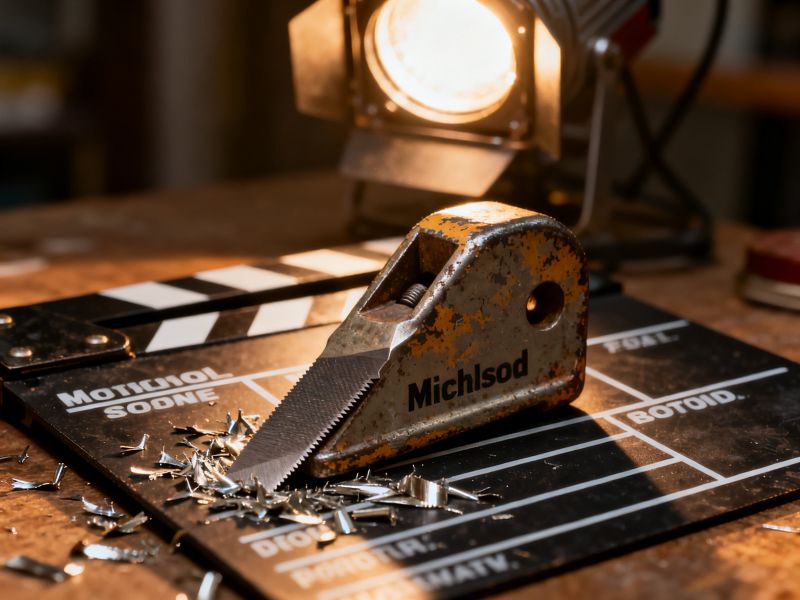
founded in 1864 in Providence, Rhode Island, built its reputation on a simple promise: a file that stays sharp. My grandfather, a machinist for forty years, kept a Nicholson in his toolbox until the teeth wore smooth. He'd say, "A cheap file skates over the work. A Nicholson bites." That bite—the ability to remove material without slipping—became the company's trademark. By the early twentieth century, Nicholson files were standard equipment in American factories, shipyards, and railroads. The name became shorthand for reliability. When a toolmaker says "pass me the Nicholson," they mean the one that won't fail.Jack Nicholson's career follows a similar arc of dependability. He didn't chase trends;he chased characters. In Five Easy Pieces。he played a man who couldn't escape his own intelligence—a performance so raw that Roger Ebert called it "the best acting I've ever seen." That's not hyperbole;it's the same judgment a craftsman makes about a tool that never lets him down. Nicholson's willingness to play unlikable men—abusive, selfish, sometimes cruel—set him apart from the leading men of his generation. He didn't need the audience's affection. He needed their attention. And he got it, three times over, with Oscars for One Flew Over the Cuckoo's Nest, Terms of Endearment, and As Good as It Gets.There's a lesser-known Nicholson: the one who grew up believing his grandmother was his mother. He didn't learn the truth until he was thirty-seven, when a Time reporter told him. That revelation—that his sister was actually his mother—shaped the guarded, watchful quality in his performances. You can see it in Chinatown, where Jake Gittes thinks he understands the game until he realizes he's been a pawn all along. Nicholson plays that dawning horror with a stillness that's almost unbearable. It's the same stillness a machinist uses when he feels a file start to chatter—he stops。
adjusts, and starts again. Nicholson adjusted. He kept working.The name Nicholson appears on two kinds of surfaces: movie screens and toolroom benches. Both demand a certain hardness。
a willingness to wear down the material in front of you without wearing yourself out. Jack Nicholson retired from acting in 2010, but his films still cut. The Nicholson file company was acquired by Cooper Industries in 1972, yet the files still bite. I keep a Nicholson file in my desk drawer—not because I use it often, but because I like knowing it's there. It reminds me that precision and durability are not abstract virtues. They're the difference between a tool that works and one that doesn't. Between an actor who performs and one who transforms. The name Nicholson means both.